By Rajender Prasad • February 14, 2026
Prepared by: Money Maestro
Industry Focus: Dubai Real Estate & Mortgage Advisory
Region: Dubai, UAE
Executive Summary
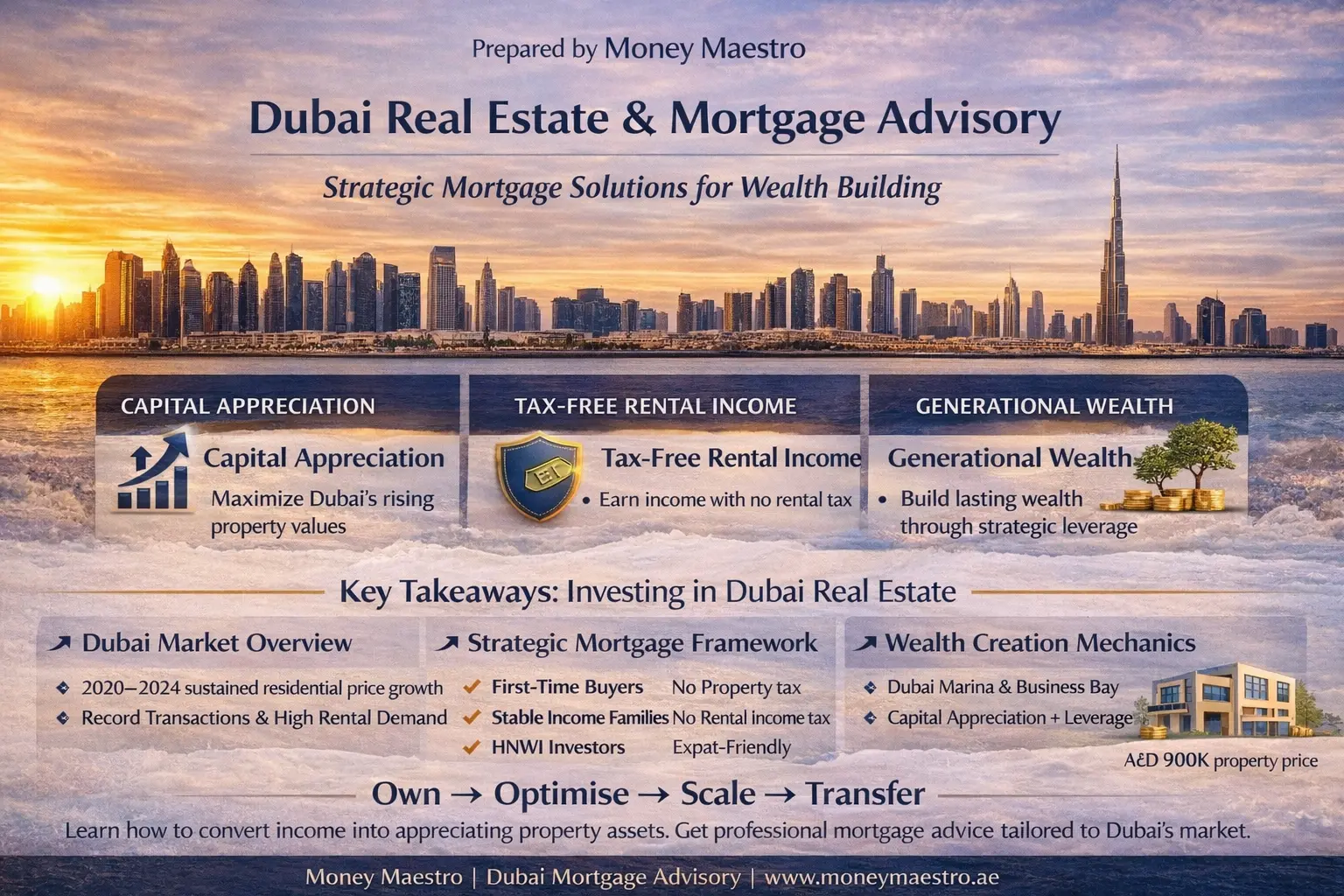
Dubai’s real estate market continues to demonstrate strong capital appreciation, robust transaction volumes, and attractive rental yields. In a tax-efficient environment with no annual property tax and no tax on rental income, structured mortgage strategies can transform salaried income into appreciating, cash-flowing assets.
This report outlines:
- Current Dubai market fundamentals
- Mortgage strategies tailored to different buyer profiles
- Risk management principles
- Real-world application scenarios
- Long-term wealth-building frameworks
The objective: demonstrate how disciplined mortgage planning builds sustainable, generational wealth in Dubai.
1. Market Overview: Dubai Real Estate Fundamentals
According to market research published by Knight Frank and regional coverage in Gulf News, Dubai has experienced:
- Sustained residential price growth (2020–2024)
- Double-digit appreciation in prime villa segments
- Record transaction volumes
- Strong rental demand driven by population growth and investor inflows
Key Structural Advantages
- No tax on rental income
- No annual property tax
- Competitive mortgage products for expats
- Higher rental yields compared to many global gateway cities
These fundamentals create a favourable environment for leveraged property acquisition when executed prudently.
2. Strategic Mortgage Framework by Buyer Profile
2.1 First-Time Buyers & Young Professionals
Strategy Theme: “Own with Discipline”
Typical Parameters:
- 20%+ down payment (expat standard requirement)
- 15–25-year mortgage tenure
- 3–5 year fixed or hybrid rate structure
Recommended Approach:
Begin with entry-level apartments in high-connectivity areas such as:
- Dubai Marina
- Business Bay
Outcome Objectives:
- Forced equity creation via principal repayment
- Hedge against rising rents
- Refinance or upgrade as income increases
- Build long-term capital appreciation
Recent policy support for first-time buyers has further stimulated demand, enhancing ownership attractiveness.
2.2 Families with Stable Income
Strategy Theme: “Home + Inflation Hedge”
For households with dependants and steady income, mortgage structuring should prioritise:
- Fixed-rate predictability
- Prepayment flexibility
- Emergency liquidity buffer (3–6 months EMIs)
Strategic Advantage:
As inflation increases rents and property prices, fixed EMIs become relatively cheaper in real terms. Over time, the property transitions from consumption expense to appreciating legacy asset.
Scaling Model:
- Upgrade primary residence
- Convert previous property into rental income stream
- Accumulate multi-generational asset base
2.3 Entrepreneurs & High-Net-Worth Investors
Strategy Theme: “Leverage for Scale”
High-net-worth individuals (HNWIs) often utilise:
- Interest-only mortgage products
- Investment property loans
- Residential + commercial diversification
When rental yields exceed financing costs, leverage amplifies returns.
Between 2020–2024, Dubai’s prime villa market delivered significant capital growth. Investors who timed market entry and held through cycles realised outsized equity gains.
2.4 Limited Savings Buyers
Strategy Theme: “Structured Entry into Ownership”
For renters with limited capital:
- Employer housing assistance programs
- Small-unit acquisition strategies
- Joint ownership structures
- Hybrid mortgage solutions
Disciplined saving combined with structured financing can transition renters into owners within 3–5 years.
3. Wealth Creation Mechanics in Dubai
3.1 Capital Appreciation
Growth corridors including:
- Dubai Marina
- Business Bay
have demonstrated strong recovery-led appreciation during recent market cycles.
3.2 Rental Yield + Leverage Effect
Dubai commonly offers competitive gross rental yields relative to mature markets. Combined with:
- Tax-free rental income
- Capital appreciation
- Structured leverage
The total return can materially exceed borrowing costs, transforming mortgages into wealth multipliers.
4. Risk Management Framework
Mortgages amplify both upside and downside. Professional structuring requires:
- EMI stress testing against rate increases
- Vacancy modelling
- 3–6 months emergency reserve (plus vacancy buffer)
- Tenure alignment with income stability
- Defined exit planning (sale, refinance, portfolio rotation)
Risk discipline protects long-term capital growth.
5. Practical Case Illustration
Profile: Mid-career expat
Asset: 1-bedroom apartment
Purchase Price: AED 900,000
Down Payment: 20%
Mortgage Tenure: 20 years
Five-Year Outcome Scenario:
- Principal repayment builds equity
- 10–15% capital appreciation enhances property value
- Rental income offsets substantial EMI portion
Result: Increased net equity enabling refinance or second acquisition — beginning portfolio scaling.
6. Strategic Advisory Advantage
Mortgage regulations, lending criteria, and down-payment requirements in the UAE evolve periodically. Strategic advisory ensures:
- Optimal lender selection
- Competitive rate negotiation
- Faster approvals
- Long-term portfolio alignment
Money Maestro provides structured mortgage modelling aligned to income, net worth, and generational wealth objectives.
Conclusion
Dubai’s real estate ecosystem presents a compelling environment for disciplined mortgage-backed ownership. When structured correctly, mortgages are not liabilities — they are strategic leverage instruments that:
- Convert income into appreciating assets
- Generate rental cash flow
- Hedge inflation
- Enable portfolio scaling
- Create generational wealth
Strategic planning, risk management, and informed lender selection are the difference between speculation and sustainable wealth building.
Contact
For a complimentary mortgage strategy consultation and scenario modelling:
Money Maestro – Dubai Mortgage Advisory
Book a strategic review to design your four-step roadmap:
Own → Optimise → Scale → Transfer