By Rajender Prasad • November 23, 2026
Money Maestro Weekly Market Letter — 20 November 2026
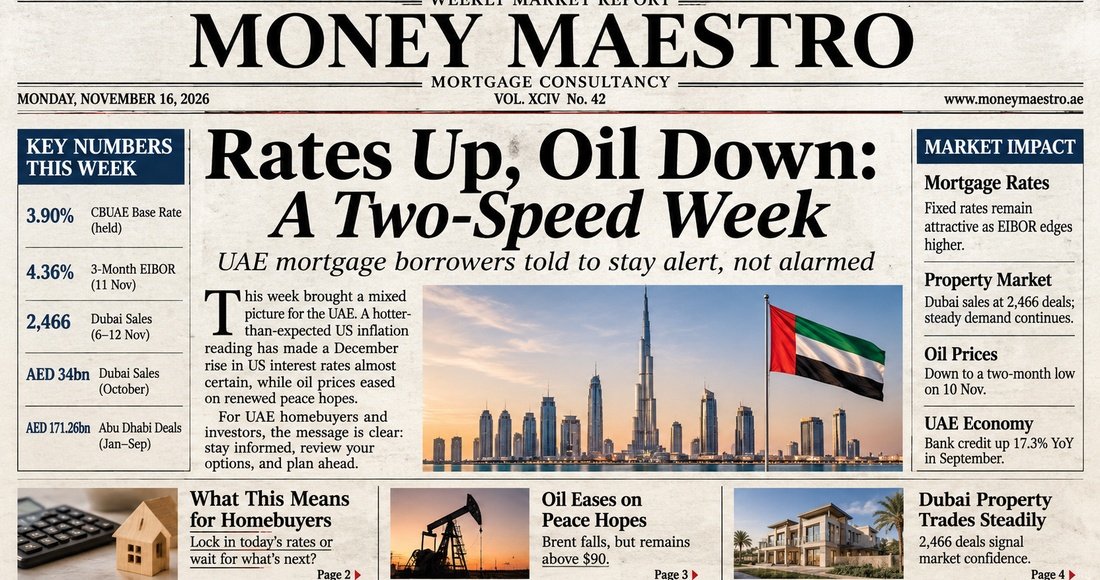
The big story this week is the growing expectation of another US rate rise in December, and because the dirham is pegged to the dollar, that matters for every UAE borrower. Some lenders have already nudged fixed rates higher, yet Dubai's property market keeps moving, and UAE banks are reporting record balance sheets. Here is what changed and what it may mean for your plans.
This Week in Numbers
| Indicator | Latest | Change / Context |
|---|---|---|
| CBUAE base rate | 3.90% | Unchanged since the 28 October hold; last raised 25 basis points in September. |
| 3-month EIBOR | About 4.29% (18 November fixing) | Down from 4.39% on 12 November. |
| 6-month EIBOR | About 4.62% (18 November fixing) | Up from 4.44% on 12 November. |
| US Fed funds range | 3.75%–4.00% | Markets price a December hike as near-certain, according to FedWatch. |
| Dubai weekly real estate deals (9–13 November) | AED 12.43 billion total | AED 8.04 billion in sales (2,433 deals); AED 2.89 billion in mortgages. |
| Dubai October sales (DXBinteract) | 11,937 deals, AED 34.0 billion | 64% of deals were off-plan or primary sales. |
Note: EIBOR figures come from rate trackers quoting CBUAE fixings. Daily movements can be noisy, so treat a one-week change with care.
Mortgage & Interest Rate Update
The direction of travel for borrowing costs is upward, even though the UAE base rate did not move this week. The Central Bank held its base rate at 3.90% in late October, after a 25-basis-point rise in September that mirrored the US Federal Reserve. Because the dirham is pegged to the dollar, the CBUAE normally follows the Fed's lead.
That is why the Fed's next meeting on 9 December matters so much here. The CME FedWatch tool showed markets pricing a December rate rise as close to certain by 12 November, up from roughly two-in-three odds in early November. The Fed's latest minutes were read as hawkish, and a stronger-than-expected October jobs report added to the pressure. If the Fed hikes by 25 basis points, a matching move in the UAE base rate would be the usual outcome.
EIBOR, the benchmark most variable UAE mortgages are priced on, was mixed over the week. The 3-month rate eased to about 4.29% on the 18 November fixing from 4.39% a week earlier, while the 6-month rate climbed to about 4.62%. Longer tenors rising suggests markets are already building in a higher rate path.
Some lenders are adjusting early. According to a rate comparison updated on 18 November, Commercial Bank of Dubai raised most of its fixed mortgage rates by 0.25% from 15 November, and Emirates NBD paused fixed rates for borrowers without a salary transfer. Headline fixed rates across 18 lenders still start from roughly 3.75% to 4.30%, with Islamic home finance providers such as Sharjah Islamic Bank, Emirates Islamic and ADIB competitive at the lower end. These are advertised rates; the rate you are offered depends on your profile, loan-to-value ratio and salary transfer arrangements.
For variable-rate borrowers: A December hike would likely feed into higher monthly payments at your next EIBOR reset.
For fixed-rate borrowers: Your rate is protected until the fixed period ends, but check when that is and what margin you revert to afterwards.
UAE Banking Highlights
UAE banks look well cushioned. Central Bank data for the third quarter, reported on 15 November, showed sector assets at a record of about AED 5.8 trillion. Non-performing loans fell to 2.3% of total loans, and credit was reported up 17.3% to around AED 2.9 trillion.
The flip side is that lending is growing faster than deposits, so banks are raising fresh capital. ADIB opened an AED 1.75 billion rights issue on 10 November, and First Abu Dhabi Bank is reported to be in early talks on a rights issue of about $5 billion, which would be the largest of its kind on the Abu Dhabi exchange. FAB has not confirmed the plan.
For borrowers, strong capital usually means banks stay keen to lend. It does not guarantee cheaper loans when funding costs are rising.
Real Estate Market Pulse
Dubai keeps trading at a healthy pace. Dubai Land Department figures for the week of 9–13 November, as reported in the local press, came to about AED 12.43 billion across sales, mortgages and gifts. Sales made up AED 8.04 billion over 2,433 deals, and mortgage registrations added AED 2.89 billion. The week's top sale was an apartment at Como Residences on Palm Jumeirah for about AED 85 million. Full DLD figures for this week (16–20 November) were not yet published when this letter was prepared.
October in Review
Dubai recorded 11,937 sales worth about AED 34.0 billion in October, at an average of roughly AED 1,639 per square foot. Off-plan and primary sales accounted for about 64% of deals, so new launches continue to drive the market. Developers launched about 6,128 units across 20 projects in the month, while about 2,289 units were handed over, including Emaar phases at Arabian Ranches III and Club Drive.
Abu Dhabi Continues Its Strong Year
Official figures released earlier this month show transaction value up about 76% to AED 171 billion in the first nine months of 2026, on roughly 38,500 deals. Investment by non-resident individuals has already more than doubled the whole of 2025.
Global Currency and Bond Market Trends
The dollar and US yields are high. The US Dollar Index pushed towards 104 and the 10-year Treasury yield sat around 5.05%, even after four days of small declines. A strong dollar keeps the dirham strong too, which can make Dubai property pricier for buyers earning in pounds, euros or rupees. High US yields also keep global borrowing costs elevated.
What This Means for You
- First-time and other buyers: Get a mortgage pre-approval now so you know your budget, and test your affordability at a rate 0.5% to 1% higher than today's quote. Remember to budget for the down payment plus DLD and other buying costs.
- Homeowners and refinancers: If your fixed period ends in the next six months, start comparing options early. Several banks still advertise fixed rates around 4%, but some are already repricing. Weigh any early-settlement fees against the potential savings.
- Investors and non-residents: With new-lease rents levelling, base your numbers on realistic rents and service charges, not best-case projections. A strong dirham changes the maths if your income is in another currency.
- Self-employed borrowers: Banks will look closely at audited accounts, bank statements and trade licence history. Gathering two years of clean records now can widen your choice of lenders and improve your terms.
- Sharia-compliant finance: Islamic home finance pricing is competitive this month, and several providers sit at the lower end of advertised fixed rates. It is worth comparing these alongside conventional options.
Let's Talk
Every borrower's situation is different, and a rate move that barely affects one family can matter a lot to another. If you would like to know how a December rate rise could affect your current mortgage, or which fixed, variable or Islamic option suits your plans, the Money Maestro team would be glad to give you a personalised, no-pressure review.
Warm regards,
Rajender Prasad
Founder & Managing Director,
Money Maestro Mortgage Consultancy
Host – Maestro Minds Podcast